Wednesday, May 16, 2012

Chunky 3-Bean Chili

This chili recipe is one I came up with after my husband and I started dating. I had never made chili before, but he liked it, so I set out to find something we would both enjoy. Neither of us is fond of tomato chunks or onion, and we don’t like things that are too spicy. This recipe is tasty without being too hot and it’s really easy. Chili makes a warm and hearty meal, which is especially nice on cold and rainy evenings. It can easily be made for a crowd. Even for just the two of us, I make it in fairly large amounts and store it in the fridge or freezer as it makes great leftovers.


1-1/2 to 2 pounds ground beef
2 teaspoons minced garlic
2 cans tomato sauce (15 oz each)
3 cans red beans (15.5 oz each)
2 cans kidney beans (15.5 oz each)
2 cans pinto beans (15.5 oz each)
1/2 cup water (optional if you like it thick)
1/4 cup plus 1 tablespoon chili powder
1 teaspoon ground cumin
1/4 teaspoon ground black pepper

Brown the ground beef with the minced garlic. My husband likes big chunks of hamburger in the chili, so I try to avoid chopping it up too fine. Keep in mind that the meat will fall apart more as you simmer the chili, so you have to start with fairly large chunks if you want it to stay chunky.


Drain the meat and add the tomato sauce, canned beans, and water (if desired). I usually partially drain the kidney beans (they have a really thick syrupy juice), but not the others.


Stir in the seasonings. The seasonings can be adjusted to your taste. I almost never measure them. Taste the liquid, and if it still tastes like tomato, add a little more chili powder. If you accidentally add too much chili powder, no problem. Just add another can of beans.


Bring the chili to a boil and then turn it down and simmer for at least 20 minutes, stirring occasionally. If it gets too thick, add a little water. Be careful not to simmer too long. You want the flavors to mix, but you don’t want to simmer it to death or you’ll get mushy soup instead of chunky chili.

Serve hot, topped with shredded cheese, and with buttered cornbread on the side. Delicious!


Linked up with WLWW, NOBH, and WFMW.

Monday, May 14, 2012

How to Settle Disagreements Without Arguing

Before we were married, my husband and I discussed how we would handle disagreements. We both agreed that we didn’t want to fight and argue. It is inevitable that disagreements of some kind will occur whenever any two people spend a lot of time together. Married couples are no exception. However, contrary to popular opinion, disagreements do not have to turn into arguments.

When disagreements arise, arguing not only causes friction in a marriage, but is often counterproductive. It's safe to say that no one changes their mind during an argument, and very few change their minds after or as a result of an argument. Bear that in mind before you let the next disagreement degrade into an argument. When you argue, each of you becomes entrenched in your position, trying desperately to convince the other person that you are right. This makes it very difficult to even listen properly to the other person since you are too focused on making them listen to you. Being in an argument also makes you emotionally vested in your own position, making it easy for pride to keep you from admitting that the other person may have a point. Add to that the fact that people often say hurtful things when defending themselves during a verbal altercation and you have a recipe for serious conflict and estrangement. Having an argument pits the two of you against each other and brings in emotions to cloud the issue. Thus, finding a solution is made more difficult.

Here is our plan for settling disagreements without arguing (and it works because we have never had an argument).

1.      Resolve to stay on the same team
As I wrote in a previous post, a husband and wife should see themselves as teammates. When a disagreement arises, the problem (not the spouse) is the opponent. It should be tackled together. The focus should be on working together to find the best solution, not on convincing the other person that you are right.

Remembering to stay on the same team can also help you avoid taking offense unnecessarily at your spouse's choice of words. If you know that your spouse is on your side, it is easier to realize that they may not have meant what they said in the way you took it. Give your spouse the benefit of the doubt and don't be quick to assume they are trying to hurt you. When you read things into what they say (that they may not have intended), you may find that you react defensively rather than logically. Avoid this pitfall by always assuming the best of your life partner rather than the worst.

2.      Don’t argue about things that don’t have to be decided now
Too many people fight about decisions that don’t have to be made right away. If you’re talking about where your kids will go to college and they’re not even in preschool yet, you’re spending way too much energy on a problem that doesn’t need to be solved yet. There’s plenty of time to decide that later. Obviously, not every issue is that extreme, but you see my point. If the decision doesn’t have to be made right now and you find yourselves at odds, don’t worry about settling on a solid solution right this minute. By all means discuss it, if you can do so calmly and rationally. But a final decision is something both of you can think about and pray about, and then decide later.

Note that this is not the same thing as simply ignoring problems. You do have to face issues and make decisions together as a couple. Ignoring problems doesn’t make them go away. Avoiding important issues may be as damaging to a relationship as having an argument. However, when a decision does not need to be made yet, fighting over it now is not going to settle things in the best way and only causes stress and conflict. Don’t force the issue now when some time in thought may be just what both of you need to get the proper perspective.

3.      When a decision must be made now, discuss it calmly and rationally
When you have a decision to make, discuss it in a calm and logical manner. Whenever a discussion becomes non-rational, it degenerates into an emotional outburst and an argument ensues. An argument is simply a case of a discussion being done irrationally.

To prevent a discussion from turning into an argument, first concentrate on really listening to what the other person is saying rather than worrying about trying to be heard. If both of you do that, you will both be heard properly. Listening well is probably the most important thing you can do to avoid arguments and solve problems properly. Remember, "listening" involves more than just hearing – it is an active process which involves understanding what the other person is trying to say.

Also, try to prevent emotion from clouding your judgment. Don’t become so vested in your position that you can’t listen to and fairly evaluate your spouse’s ideas as well. Consider that you may be wrong or that your spouse may have valuable insights also. Once you both understand each other’s ideas thoroughly, you are in a much better position for making a good decision.

Another thing to do is to find out what it is that you and your spouse really want. Sometimes what we really want isn’t what we say we want (or even what we think we want). For example, maybe a husband insists on a trip to the mountains rather than the beach in July because he doesn’t like crowds or because it’s cooler rather than because he just loves the mountains. Considering his concerns about the beach may help in finding a good solution that both of you like.

4.      Consider the major pros and cons of various options and make a decision together
Working together, weigh the various options to find the best solution. Consider as many aspects of the issue as you can. Consider hidden costs and risks in making your assessment. And, yes, your feelings and your spouse’s feelings on the subject are valid things to consider. If it’s very important to one of you, that is definitely something to think about. It’s also important to consider what each of you knows about the subject. If you’re making a decision and one of you is more knowledgeable on the topic, take that into consideration. On the other hand, just because one of you is more knowledgeable on a topic doesn’t mean you can disregard or belittle the input of your spouse. When you can’t decide on the best course of action, consider the possibility of a third option or a compromise that will satisfy both of you.

In all of this, be sure to evaluate your own ideas as rigorously as your spouse’s. You don’t get to ignore the flaws in your own plan. When your spouse has a good idea, be humble enough to recognize that, even if it means admitting that your idea wasn’t as good. Remember, the goal is to reach the best solution together. When you do that, you both win.

In most cases, an agreement can be reached through these 4 steps. When that doesn’t happen, you have to go to step 5.

5.      When a decision must be made and no agreement is reached, someone must make the final decision
Since there are only two of you, if you cannot agree on a solution and a decision must be made now, one person must make the decision. You should decide ahead of time who will make the final decisions in such circumstances. I believe that the husband is the leader of the home and should make the decision in such cases. If my husband and I ever come to an impasse, we have already decided that he will make the final decision. This circumstance should be rare, however, if disagreements are handled properly. In our marriage, we have very rarely had to use this step in making a decision.

One thing that my husband always points out when we talk about this is that the fact that the husband makes the decision (in these extreme cases) doesn’t mean that he should simply go with his idea. A good leader will not flaunt his position or run roughshod over those he leads. A good husband takes his wife’s ideas and concerns into consideration when making a decision. As my husband says, a man should consider that:
1.      His wife may be more knowledgeable in this area
2.      Her concerns may be valid, even if he doesn’t share them
3.      One of his main duties in life is to make his wife happy
Thus, he may find that choosing his plan may not be the best course of action. He should take all of this into consideration and make the decision that is best for the couple (or the family), not simply the decision that suits him best. (I am so glad my husband thinks this way. I have an amazing man!)

In such cases where the husband makes the final decision, the wife should uphold the husband’s decision as if it were her own. Even when the man makes the final decision, the decision was really made by the couple (they both decided to do it this way, remember). Complaining behind his back or trying to undermine his decision should both be shunned. And if the decision he makes doesn’t work out, don’t ever say “I told you so.” All of these responses are detrimental to building a good marriage.

So, yes, it really is possible to handle disagreements without arguing. This plan has worked for us, and I believe it will work for anyone. It does, however, take some purposeful planning (well in advance) and proper thinking so that a husband and wife can handle disagreements by working them out rationally as a team. The need for rational and logical discussion (on the part of both husband and wife) in any case of disagreement cannot be overemphasized. Also, remembering the fact that husband and wife are on the same team is vitally important. Keep these tips in mind, put them into practice, and you should find that you can settle your disagreements without arguing. May God bless your marriage!


Linked up with WLWW, Yes They're All Ours, NOBH, WFMW, To Love Honor and Vacuum, TPT, Warrior Wives, and The Alabster Jar.

Tuesday, May 8, 2012

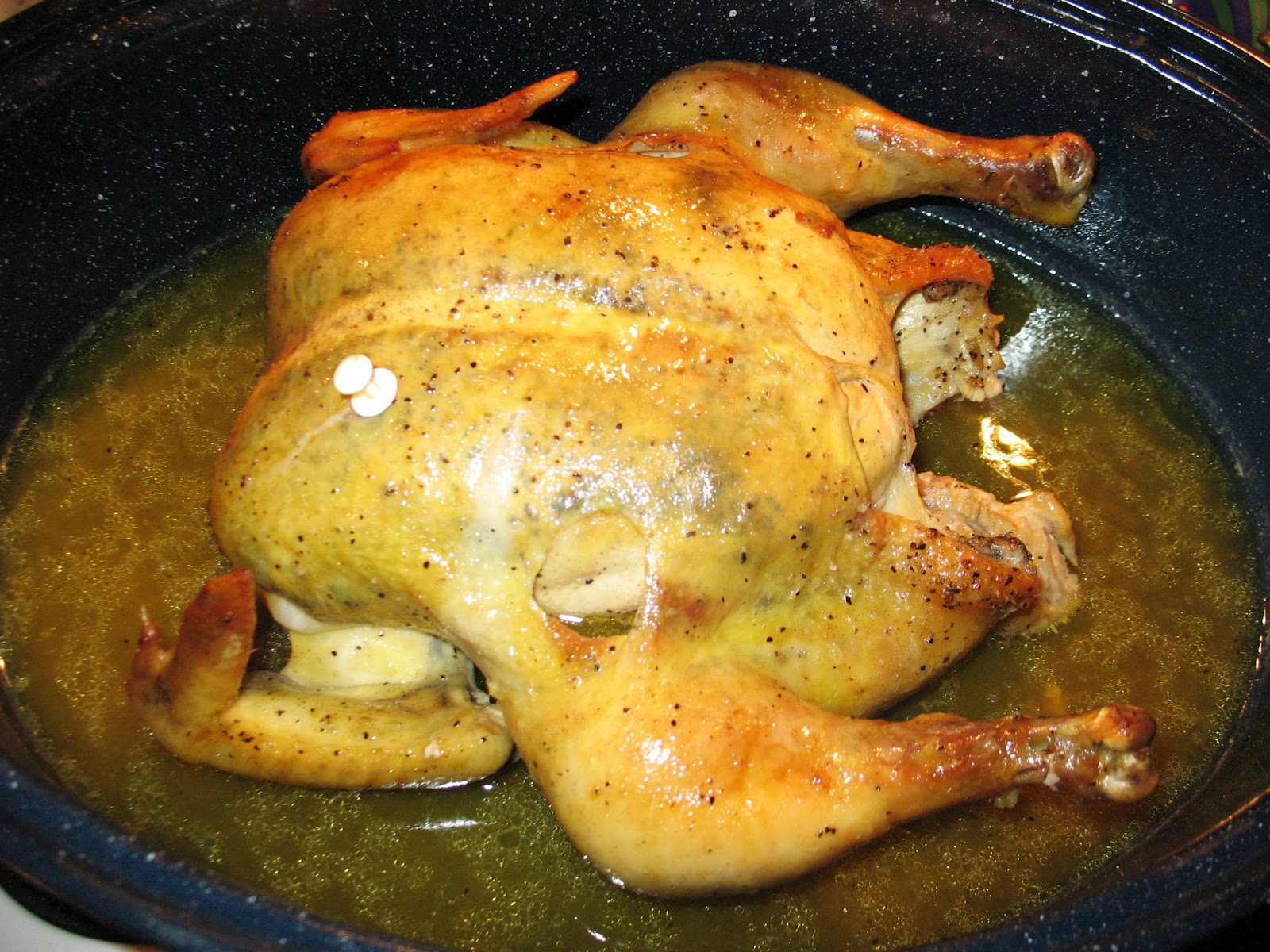
Simple Roast Chicken (with Gravy)

This recipe is what I use to make a roast chicken dinner. It’s one of my husband’s favorite meals and it’s so easy and delicious. My husband and I prefer white meat so this recipe is designed to make the breast meat especially tasty. I usually use the leftover dark meat for a chicken pie.


1 whole chicken (5-7 pounds)
2 tablespoons lemon pepper
1/2 teaspoon sage
1/2 teaspoon thyme
1/2 teaspoon ground black pepper
2 teaspoons salt
3-4 tablespoons butter
2-1/2 cups water

Rinse the chicken well, inside and out, and remove any giblets. (You can save the giblets if you want to use them for gravy, but this recipe makes really good gravy without messing with the giblets.) Place the chicken, breast side up in a roasting pan or baking dish.


Gently separate the skin from the chicken breast. You can either slide your fingers under the skin or use a spoon or other object. You don’t want to tear the skin or take it off the chicken, just make a pocket under the skin to place the seasoning in. Try to leave the skin attached along the breastbone (center line). If you have a pop-up thermometer in your bird, you may want to remove it first and replace it before you put the chicken in the oven.


Mix the spices together in a small dish and then spread about 1/3 over the breast meat, under the skin. I have found it easiest to scoop up spices with a spoon, insert the spoon under the skin, and then rotate the spoon to pour the spices onto the meat. You want to coat the entire surface of the breast meat with the spices.

Next, melt the butter and place about 1/3 on the breast meat, under the skin. Again, a spoon is really useful for this. When you’re done, you should have both butter and spices coating the breast meat.

Spread the remaining butter over the inside and outside of the chicken and sprinkle with the remaining spices. Pour the water into the bottom of the pan. Be careful not to pour it over the chicken or it will wash off the spices.


Bake the chicken at 350○F. After one hour, begin basting the chicken about every 20 minutes with the juices from the bottom of the pan.

Cook the chicken for a total of 2 to 2-1/2 hours (depending on the size of the bird). If you’re a little late getting it in the oven, turn the oven up to 375○F and you will save about 20-30 minutes. The chicken is done when a meat thermometer inserted in the thickest part of the thigh reads 180○F or when the juices run clear when you poke a hole in the leg meat. If you have a pop-up thermometer in the bird, they are generally accurate (although I have had some that just refuse to ever pop up).

Once the chicken is done, remove it from the oven, baste it one last time, and let it set for about 15 minutes before carving.


While the chicken is setting, you can make the gravy. Place the juices from the roasting pan in a small saucepan and heat until gently boiling. You may want to use a baster to take the juices from the bottom as the fats will be on top and can be left in the roasting pan. This will reduce the amount of fat in the gravy and make it less likely to separate. If the juices look (or taste) very strong, you may want to add some water to them (which will also make more gravy). Mix about 1/3 cup cornstarch with 1 cup of water in a cup or small bowl. You want the mixture to have plenty of cornstarch without being hard to pour. Once the chicken juices are boiling, add the cornstarch mixture slowly, stirring as you pour, until the gravy thickens to the desired consistency. You shouldn't need to add any other spices to the gravy since it's really good as it is.

Carve the chicken and serve with your choice of veggies and mashed potatoes (with gravy, of course).


Linked up with WLWW, WFMW, and NOBH.

Thursday, May 3, 2012

Lullabies

Many women, including me, sing lullabies to their children. It’s something that babies enjoy, and often even older children find it soothing. Lullabies are a great way to soothe your children, assure them of your love, pray a blessing over them, or teach them about Jesus. Here are some special lullabies that I sing to my baby.

The first one is a lullaby my mom wrote for me when I was a baby. She had never liked the words to the traditional “Rock-A-Bye Baby” song. It’s all about a baby falling out of a tree…not the most comforting thought. So she wrote a version with the same tune that she liked better, and I sing it now to my little girl. 

Rock-a-bye baby, in mommy’s arms,
Lying so snug and safe from all harm.
Now, as you slowly drift off to sleep,
May Jesus bring you dreams so sweet.


The second one was also written by my mom, but years later when I was a teenager. She would sing it to my younger sisters. I call this one the Blessing Lullaby.

May the Lord bless you and keep you.
May His face always shine upon you.
May you serve the Lord Jesus all the days of your life
That you may dwell in the house of the Lord.


The third one I wrote for my baby while I was pregnant. I had about an hour drive to where I was teaching part time and I wrote this in the car one day.

Little baby, sleeping gently,
Rest while I hold you,
There’s nothing to fear.
Little baby, sleeping angel,
Know that I love you
And I always will.


Are there any special lullabies that you sing to your children? Comment below to share them.


Linked up with WLWW, No Ordinary Blog Hop, WFMW, and Yes They're All Ours.

Tuesday, May 1, 2012

Cohabitation is Not Practice for Marriage

Some people think that you have to know everything about someone and try them out (including in bed) before making a marriage commitment. They think it’s safer, more loving, and more practical to live together before marriage. After all, knowing the other person intimately beforehand should make sure you don’t get any unpleasant surprises after the wedding, right? However, a closer examination shows that it doesn’t really work that way. Aside from the fact that cohabitation (i.e. an unmarried couple living together) is morally wrong, there are a number of practical reasons that it doesn’t lead to safer, more secure, and more loving marriages.
Some say that cohabitation is practice for marriage, but this does not hold up logically or observationally. Studies have shown that  cohabiting couples are actually less likely to marry than those who do not. Even if they do marry, they are more likely to have marriage problems and more likely to divorce. This is simply a natural result because the nature of cohabitation is dramatically different from that of marriage. In reality, cohabitation is the antithesis of marriage.
Commitment is the very essence of marriage. Many types of relationships contain elements in common with marriage, including companionship, sharing of living space and/or finances, and sexual expression, but only marriage is based on a lifetime commitment between a man and a woman. Because cohabitation is not a committed relationship, it cannot be practice for marriage. There is no way to practice making a commitment. You either make a commitment or you do not. Because cohabitation includes many of the elements of marriage without the essential one, it instead makes a mockery of marriage. It is a cruel parody that places the supposed lovers in the position of exposing themselves to each other without the supporting framework of commitment that a sexually intimate relationship was meant to have.
Marriage is meant to be a lifetime commitment between a man and a woman in which they physically, spiritually, and emotionally bond to become one. This bonding of the entire self only works properly when all other options are permanently rejected. It is the nature of erotic love to include only two people. Each person has only one self and can only give that self wholly to one other. In order to bind oneself so tightly to another, it is necessary to forego binding in that way with any other at any time. Thus true love requires commitment. Cohabitation is not a loving relationship because it does not permanently exclude all others. When two people are  cohabiting before marriage, they are putting off commitment because they are waiting to see if anything better comes along.  Cohabiting couples want to have their cake and eat it too. They want sex and companionship now, but with the easy option to get out when things get tough. A person who is “keeping their options open” is not exhibiting love.
Marriage is designed to be a safe and loving environment for the sharing of self. When two people commit to each other before sexual intimacy, they affirm that their love for the other person is not contingent on bedroom performance (or anything else). True love says “I love you, whatever the cost may be, no matter what I may find out about you in the future, and nothing you do will ever change that.” When two people who have remained sexually pure commit to one another in marriage, they show the ultimate expression of love. They commit to one another without reservation, without exception clauses, without knowing everything, but having decided that whatever they may learn will not induce them to reject the other person. It takes courage and sacrifice to love like that. But anything less than full commitment is not true love.

Conversely, cohabitation before marriage is not an environment that builds love and trust. Cohabitation, as a “trial period,” says to the other that they better measure up or else. It is an inherently selfish relationship that objectifies the other person. The emphasis in cohabitation is on getting what you want out of the relationship, which is the exact opposite of the emphasis in marriage, which is giving of yourself for the good of the other person. What is loving about taking pleasure in another’s body with the understanding that you may simply walk away if they don’t please you enough?  Cohabiting couples end up evaluating each other’s merits rather than giving of themselves. Their relationship is based on scrutiny rather than acceptance. Such an environment is not likely to build a healthy and lasting relationship.
Cohabitation before marriage also takes the joy of discovery out of the first part of marriage. The first few months of marriage are meant to have a lot of surprises. The newlyweds should have fun finding out what the other likes and how to please one another in an environment of mutual trust and commitment. There should be an air of excitement as they try new things together for the first time. Experiencing new and intimate things with the other person under the umbrella of a marriage commitment takes much of the performance pressure off and is crucial in building a strong and lasting bond between them. It allows both partners to be themselves without fear of rejection since the other person has already committed to them for life. On the other hand, marriage between two people who have cohabited has no spark of excitement, no thrill of discovery, nothing new to learn. The wedding, meant to be a new beginning, becomes a mere formality. How is their wedding night different from any other? She knows how he snores. He knows what her hair looks like in the morning. They’ve already done it all. It’s just official now. Cohabitation before marriage robs marriage of much of the excitement it was meant to have.
In so many ways, cohabitation is sorely lacking as an alternative or precursor to marriage. It shows superficial similarities to marriage, but on closer examination, they are dissimilar in every way that matters. Cohabitation is not practice for marriage and does not build the type of relationship that leads to a successful marriage. It is a cheap counterfeit that should not be peddled as a valid step in building a strong relationship.
So, for those of you who may be contemplating moving in with your girlfriend or boyfriend, please don't. Wait for marriage. It's well worth the wait.